

























Haritaki (Terminalia chebula): Traditional Use, Research & Extract Types

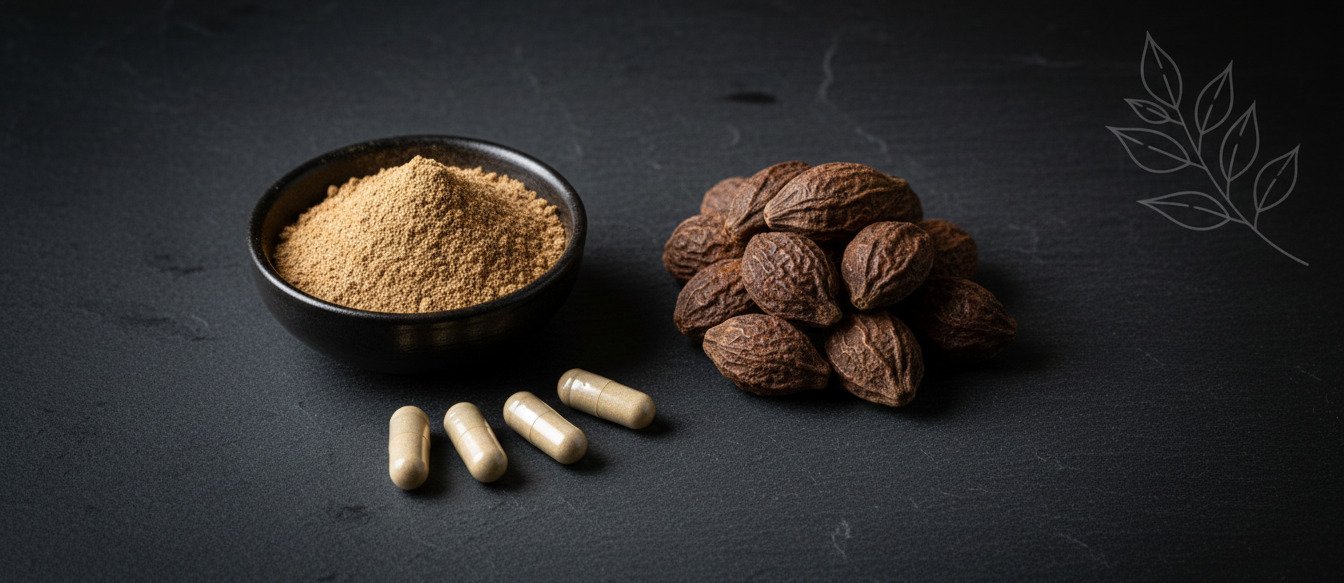
Haritaki Terminalia chebula, commonly known as Haritaki, is one of the most respected fruits in traditional Ayurvedic systems. It has been used for centuries and has also attracted modern scientific interest due to its naturally occurring plant compounds.
This guide explores:
- What Haritaki is
- How it has been traditionally used
- What modern research has studied
- The difference between Haritaki extracts and whole-fruit powders
This article is for educational purposes only and does not provide medical advice.
What Is Haritaki?
Haritaki (Terminalia chebula) is a fruit native to South Asia. It contains a wide range of naturally occurring compounds including:
- Tannins
- Polyphenols
- Flavonoids
- Organic acids
These compounds are the focus of most scientific research on Haritaki.
Traditional Use of Haritaki
In Ayurveda, Haritaki has traditionally been used in formulations related to:
- Digestive traditions
- Internal cleansing
- Rejuvenation practices
- General wellness
These traditional uses inspired modern scientific studies.
What Modern Research Has Studied
Modern research has focused on Haritaki’s antioxidant, microbial, and metabolic properties.
Antioxidant & Cellular Research
A review in Journal of Ayurveda and Integrative Medicine highlighted Haritaki’s polyphenol and antioxidant profile.
Source: Saleem et al. (2002). Terminalia chebula: A pharmacological overview.
Microbial & Gut-Related Studies
Research in BMC Complementary Medicine examined Haritaki extracts for their interaction with microbial activity.
Source: Bag et al. (2013). BMC Complement Altern Med.
Metabolic & Cellular Protection
Studies in Phytotherapy Research explored Haritaki fruit extracts in relation to oxidative stress and cellular pathways.
Source: Naik et al. (2004). Phytotherapy Research.
These studies were conducted using standardized extracts, not consumer supplements.

Haritaki Extract vs Organic Haritaki Powder
Haritaki products are available in two main forms.
Haritaki Extract
Extracts are produced by concentrating compounds from the fruit.
Ratios such as 10:1 mean:
10 kg of fruit is used to make 1 kg of extract
👉 View Haritaki Extract 10:1 Powder
👉 View Haritaki Extract Capsules
Organic Haritaki Powder
Organic Haritaki powder is made from dried whole fruit and contains Haritaki in its natural, un-concentrated form.
👉 View Organic Haritaki Powder
👉 View Organic Haritaki Capsules
Why Standardization Matters
Most scientific studies use standardized Haritaki extracts, not whole-fruit powder.
This allows researchers to:
- Measure polyphenol content
- Compare results
- Maintain consistency
Important Reminder
Scientific research studies extracts under controlled conditions.
Retail supplements are not evaluated the same way.
Final Thoughts
Haritaki remains one of the most valued fruits in traditional Ayurvedic practice and continues to be widely studied today. Whether used as a standardized extract or an organic whole-fruit powder, it remains popular in botanical wellness traditions.
Compliance Disclaimer
This article is for educational purposes only.
It does not provide medical advice.
Dietary supplements are not intended to diagnose, treat, cure, or prevent any disease.