
























Moringa (Drumstick Tree): Traditional Use, Research & Whole-Leaf Powder Explained


Moringa, commonly known as the Drumstick Tree, is botanically identified as Moringa oleifera. It has been traditionally consumed as a nutrient-dense leaf food across India, Africa, and Southeast Asia. Unlike many herbs that rely on extracts, moringa is primarily valued and studied in its whole-leaf powder form.
This guide explains:
- What Moringa is
- How it has been traditionally used
- What modern research focuses on
- Why organic whole-leaf powder is not inferior to extracts
This content is for educational purposes only and does not provide medical advice.
What Is Moringa?
Moringa is a fast-growing tree whose leaves are the most commonly used part. Moringa leaves naturally contain a broad nutritional and phytochemical spectrum, including:
- Plant proteins and amino acids
- Vitamins and minerals
- Polyphenols and flavonoids
- Chlorophyll and antioxidants
- Dietary fiber
These nutrients and compounds act together in the whole leaf — not as isolated markers.
Traditional Use of Moringa
In Ayurveda, African traditional diets, and tropical food systems, moringa leaves have been used as:
- A daily green superfood
- A nutritional support ingredient
- A food-based botanical for long-term use
- A leaf vegetable (fresh, dried, or powdered)
Historically, moringa has been consumed as whole leaves or leaf powder, not as concentrated extracts.
What Modern Research Has Studied
Modern research on moringa overwhelmingly focuses on whole leaf powder, dried leaves, or leaf-based preparations.
Nutritional & Leaf-Based Research
A review in Food Science & Nutrition analyzed moringa leaf powder for its nutritional density and antioxidant profile.
Source: Leone et al. (2015). Food Sci Nutr.
Botanical & Dietary Studies
Research in Journal of Food Composition and Analysis evaluated dried moringa leaf powder as a functional food ingredient.
Source: Saini et al. (2016). JFCA.
Traditional Food Research
A review in Plants highlighted moringa leaves as a nutrient-rich traditional food, emphasizing whole-leaf use.
Source: Gopalakrishnan et al. (2016). Plants.
👉 Key Insight:
Most moringa research is leaf-based and food-oriented, not extract-focused.
Moringa Powder vs Extracts (Important Clarification)
Unlike herbs that rely on a single active compound:
- Moringa’s value comes from nutrient synergy
- Isolating compounds through extraction reduces the food-matrix effect
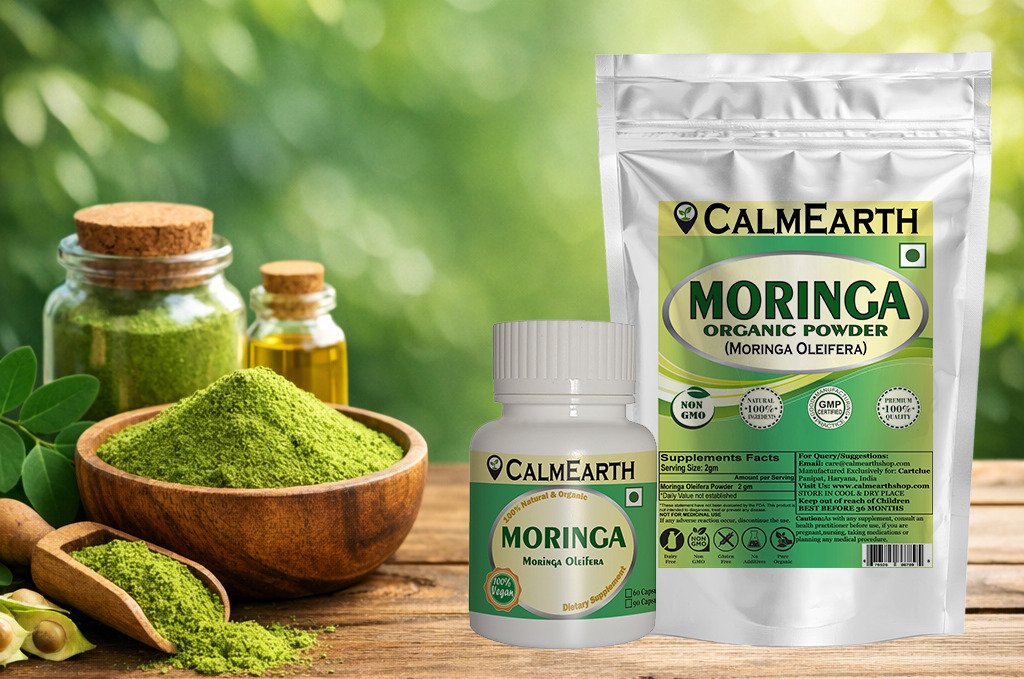
Organic Moringa Leaf Powder
- Full-spectrum nutrition
- Reflects traditional dietary use
- Matches most scientific study formats
- Ideal for daily and long-term use
- 👉 View Moringa Organic Powder
- 👉 View Moringa Organic Capsules
Moringa Extracts (Less Representative)
- Concentrate selected compounds only
- Do not reflect traditional food use
- Less commonly used in moringa research
👉 Conclusion:
For moringa, organic whole-leaf powder is the preferred and research-aligned format, not an inferior option.
Why Organic Matters for Moringa
Moringa is often consumed daily and in food-like amounts.
Organic sourcing ensures:
- No synthetic pesticide residues
- Cleaner nutritional profile
- Better suitability for long-term use
Important Reminder
Scientific research studies moringa in food and botanical contexts.
Retail dietary supplements are not evaluated in the same way.
Final Thoughts
Moringa (Moringa oleifera) is best understood as a nutrient-rich leaf food, not a compound-driven herb. Organic whole-leaf powder preserves the plant’s natural complexity and aligns with both traditional use and modern research.
Compliance Disclaimer
This article is for educational purposes only.
It does not provide medical advice.
Dietary supplements are not intended to diagnose, treat, cure, or prevent any disease.