








Neem Leaf Powder (Azadirachta indica): Traditional Use, Research & Whole-Leaf Powder Explained


Neem leaf powder, botanically known as Azadirachta indica, is one of the most respected traditional botanicals in South Asian wellness systems. For centuries, neem leaves have been used in whole or powdered form, not primarily as isolated extracts.
This guide explains:
- What Neem is
- How it has been traditionally used
- What modern research focuses on
- Why organic whole-leaf powder is not inferior to extracts
🌿 Shop the CalmEarth range → Browse our Hair & Skin collection and discover more from our full herbal range.
This content is for educational purposes only and does not provide medical advice.
What Is Neem?
Neem is an evergreen tree whose leaves are widely used in traditional practices. Neem leaves naturally contain a complex spectrum of plant compounds, including:
- Limonoids
- Flavonoids
- Polyphenols
- Tannins
- Bitter principles
These compounds function together in the whole leaf, not as isolated single markers.
Traditional Use of Neem
In Ayurveda, folk medicine, and traditional daily routines, neem leaves have been used for:
- Daily cleansing and balance practices
- Seasonal wellness traditions
- Food-adjacent and lifestyle applications
- Long-term, low-dose botanical use
Historically, neem has been consumed as:
- Fresh leaves
- Dried leaf powder
- Water-based preparations
Whole-leaf use is the traditional standard, not extracts.
What Modern Research Has Studied
Modern scientific research on neem largely focuses on leaf powder, dried leaves, or whole-leaf preparations, rather than highly concentrated extracts.
Phytochemical & Leaf-Based Research
A review in Journal of Ethnopharmacology examined neem leaf composition and traditional usage, emphasizing whole-leaf phytochemistry.
Source: Subapriya & Nagini (2005). J Ethnopharmacol.
Botanical & Traditional Reviews
Research published in Current Medicinal Chemistry discussed neem as a multi-compound botanical traditionally used in whole form.
Source: Biswas et al. (2002). Curr Med Chem.
Food & Herbal Context Studies
A review in Asian Pacific Journal of Tropical Biomedicine highlighted neem leaf powder in traditional and dietary contexts.
Source: Alzohairy (2016). APJTB.
👉 Key Insight:
Neem research supports whole-leaf, multi-compound use, not single-compound extraction.
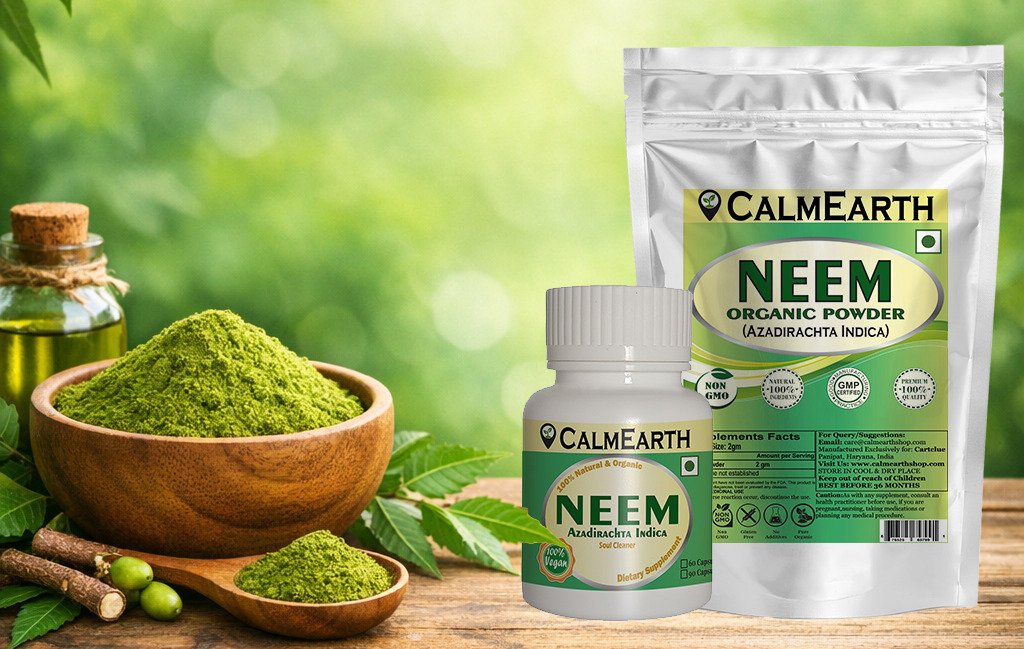
Neem Powder vs Extracts (Important Clarification)
Neem does not depend on one “active ingredient.”
- Its value comes from bitters + polyphenols + limonoids working together
- Extracting selected compounds alters the traditional balance
Organic Neem Leaf Powder
- Full-spectrum leaf composition
- Matches traditional and research-aligned use
- Suitable for long-term, routine use
- 👉 View Neem Leaf Powder
- 👉 View Neem Leaf Capsule
Neem Extracts (Less Representative)
- Concentrate selected compounds only
- Less aligned with traditional neem usage
- Not the primary format in most neem research
👉 Conclusion:
For neem, organic whole-leaf powder is the authentic and preferred format, not an inferior one.
Why Organic Matters for Neem
Neem is often used regularly and over long periods.
Organic neem powder ensures:
- No synthetic pesticide residues
- Cleaner bitter compound profile
- Better suitability for routine use
Important Reminder
Scientific research studies neem in traditional and botanical contexts.
Retail dietary supplements are not evaluated the same way.
Final Thoughts
Neem (Azadirachta indica) is best respected as a whole-leaf botanical, not an extract-driven supplement. Organic neem leaf powder preserves the plant’s natural complexity and aligns with both traditional wisdom and modern research.
Compliance Disclaimer
This article is for educational purposes only.
It does not provide medical advice.
Dietary supplements are not intended to diagnose, treat, cure, or prevent any disease.