








Pueraria Mirifica Extract: Traditional Use, Research & What 10:1 Means

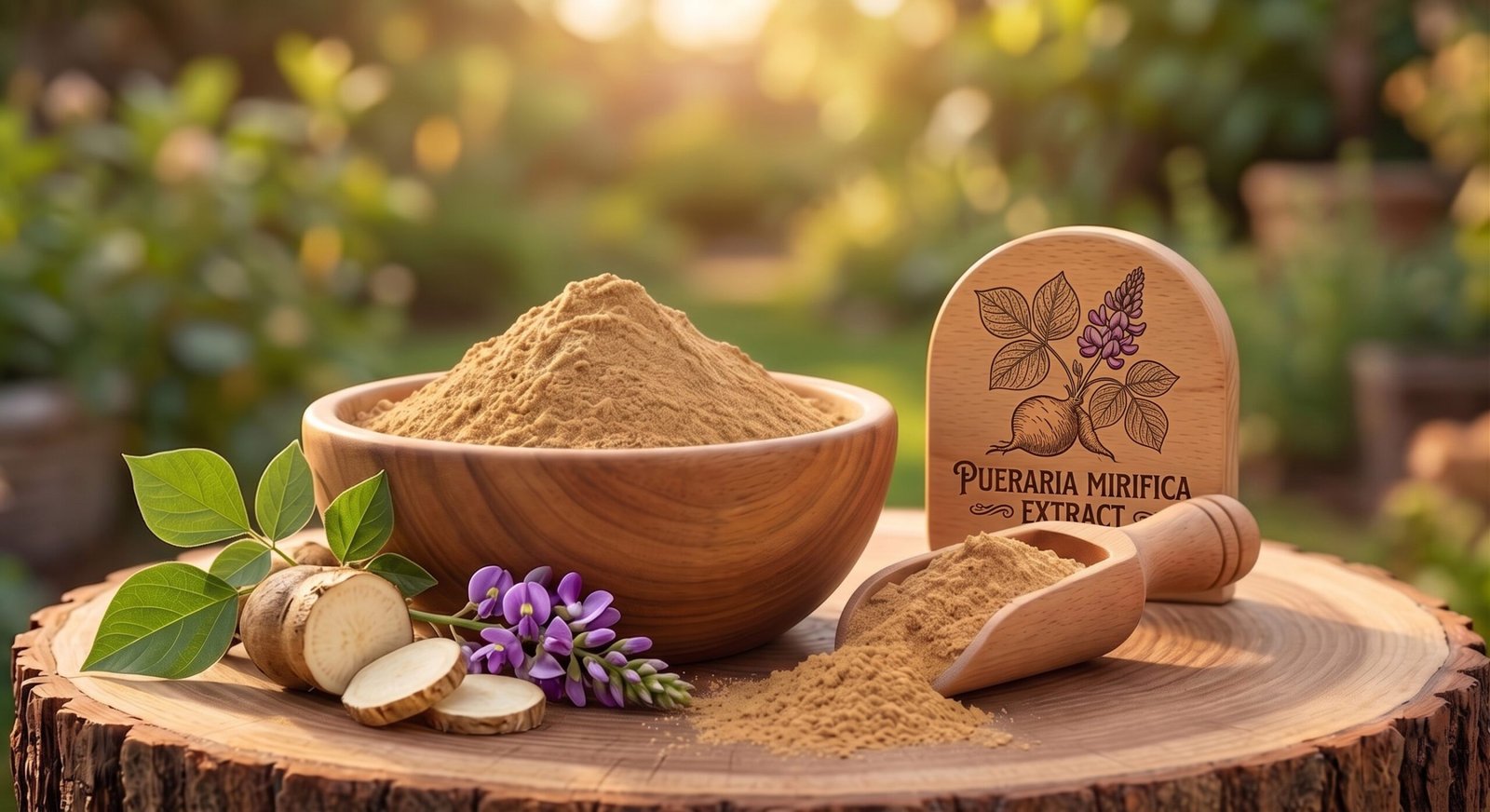
Pueraria mirifica is a leguminous vine native to northern and western Thailand and parts of Myanmar, known locally as Kwao Krua Kao or white kwao krua. The tuberous root has a documented history in Thai traditional practice and has since become one of the more intensively studied phytoestrogenic botanicals — and one of the more difficult to standardize. Extracts are commonly supplied as ratio concentrates such as 10:1.
This article covers four things:
- What Pueraria mirifica is and which compounds define it
- How the root has been traditionally used in Thailand
- What modern research has examined, including its documented limitations
- What a 10:1 ratio actually specifies — and what it does not
🌿 Explore Herbal Extract Powders
This article is educational in nature and is not intended to diagnose, treat, cure or prevent any disease. Pueraria mirifica is a hormonally active botanical and is not suitable for everyone — see the safety section below.
What Is Pueraria Mirifica Extract?
Pueraria mirifica extract is produced from the dried tuberous root of Pueraria candollei var. mirifica. The root is cleaned, sliced, dried and milled, then extracted — most commonly with ethanol or a hydro-alcoholic solvent — before the concentrate is dried into a powder.
The compounds that define the species include:
- Benzopyranoids — deoxymiroestrol and miroestrol, the diagnostic markers for the species and among the most potent plant-derived estrogenic compounds identified. Deoxymiroestrol is the native form; miroestrol is largely an oxidation product formed during processing and storage
- Isoflavones — puerarin, daidzein, genistein and the species-specific kwakhurin
- Coumestans — coumestrol and the mirificoumestans
An important practical point: the benzopyranoids are chemically unstable. Deoxymiroestrol oxidises to miroestrol on exposure to air and heat, which means the profile of a given batch depends heavily on how it was processed and stored, not only on the raw material.
Note also that Pueraria mirifica is a distinct species from Pueraria tuberosa (Indian kudzu, vidarikand) and from Pueraria lobata (Chinese kudzu). The three are not interchangeable and have materially different constituent profiles.
Traditional Use of Kwao Krua Kao
Pueraria mirifica has been used in Thai folk practice for over a century. The ethnobotanical record describes it primarily as a rejuvenating tonic for older adults.
Traditionally documented applications include:
- Use as a general rejuvenating tonic in later life
- Preparation of the dried, powdered root taken in small escalating amounts
- Application in traditional formulations addressing age-related complaints
- Topical preparation of the root in some regional practices
Traditional dosing was low and cautious — the recorded range is roughly 30–500 mg per day with gradual escalation, which is notably conservative for a traditional botanical and suggests the potency of the material was recognised in practice.
What Modern Research Has Studied
Research on Pueraria mirifica has followed three tracks: identifying and quantifying its constituents, testing extracts in animal models, and running clinical trials in defined populations. The summaries below describe what was studied and what the researchers themselves flagged as limitations.
Phytochemistry & Standardization Research
Zeng and colleagues (2026), in a critical review in Frontiers in Pharmacology, consolidated the phytochemistry, pharmacology and standardization literature for the species. The review documents how much the material varies: total isoflavone content differs more than tenfold between Thai growing provinces, and seasonal variation can shift isoflavone levels by a factor of 15 to 37 between dry and rainy season harvests.
The authors’ central argument concerns quality control. They propose that an adequate framework requires five elements — authenticated botanical identity, control of raw material origin and harvest conditions, chemical fingerprinting against prioritised markers, batch-to-batch consistency testing, and bioactivity-linked evaluation. They specifically criticise reliance on single-marker quantification as insufficient for this species.
Analytical & Authentication Methods
Because Pueraria mirifica is adulterated with and confused for related species, a body of authentication work has developed alongside the chemistry. Published approaches include LC-MS/MS quantification of benzopyranoids and isoflavones, ELISA and immunochromatographic assays for miroestrol, and PCR-based molecular methods including PCR-RFLP and ARMS for confirming species identity.
The existence of this literature is itself informative: species authentication is treated as a necessary quality step for this botanical, not an optional one.
Preclinical & Clinical Studies
Animal work has examined the extract’s estrogenic activity in rodent and primate models. This literature also produced the principal safety findings, summarised in the next section.
Human trials have been conducted, mostly in postmenopausal women, examining endpoints including lipid profiles and bone turnover markers (Manonai et al., Menopause, 2008) and vaginal artery vascularization (Maturitas, 2022). A systematic review in the Journal of Ethnopharmacology (2018) assessed this trial literature and reported consistent limitations: small sample sizes, short intervention periods, heterogeneous formulations, and incomplete characterisation of the material tested.
Two further findings complicate interpretation. Oral bioavailability of puerarin is low — around 7% in rodents and under 1% in non-human primates. And only an estimated 30–50% of people carry the gut microbiota needed to convert daidzein into S-equol, its more active metabolite, meaning response varies by individual for reasons unrelated to the product.
As with any botanical, these studies were conducted on characterised material under controlled conditions. They are not evaluations of retail supplements and their findings do not transfer to specific commercial products.
What a 10:1 Ratio Extract Actually Specifies
A 10:1 designation is a concentration ratio, not a marker standardization. It states that ten weight units of dried starting material were used to produce one weight unit of finished extract. This is a different kind of claim from a percentage specification such as “0.6% glucosinolates” or “15% sterols”.
What the ratio does and does not tell you:
- It describes process, not content. It says how much raw material went in — not how much of any compound came out
- It is only as good as the input. Given the tenfold provincial and 15–37× seasonal variation documented for this species, two genuine 10:1 extracts can differ substantially in constituent levels
- It says nothing about the marker compounds. Deoxymiroestrol and miroestrol content is not implied by the ratio
- It does not confirm species identity. Ratio alone cannot distinguish P. mirifica from related Pueraria species
- It is not directly comparable across suppliers. Solvent system, extraction conditions and drying method all affect the result
For this particular botanical, a ratio figure should be read alongside three other things on the documentation: a species authentication result, a marker assay for benzopyranoids or isoflavones with the method named, and storage conditions — since the diagnostic compounds degrade.
Pueraria Mirifica Extract Powder 10:1
Pueraria Mirifica Extract Capsules 10:1
Why Standardization Matters Here in Particular
For most botanicals, standardization is about consistency and formulation convenience. For Pueraria mirifica the argument is stronger, because the source material is unusually variable and the active compounds are unusually potent.
- Variability is documented and large — tenfold by region, up to 37-fold by season
- Marker compounds are unstable — the profile changes with processing and storage, not just with the harvest
- Species substitution is a known issue — which is why molecular authentication methods were developed for it
- Potency is high — meaning batch variation has more consequence than it would for a mild botanical
Safety, Contraindications & Regulatory Status
This section exists because the published safety literature on this species is substantial and should not be omitted from an educational article about it.
Reported findings in animal studies include endometrial hyperplasia and endocrine disruption at higher doses, reduced fertility measures in both sexes, and in non-human primates, amenorrhea described in the literature as irreversible. The reported Lowest Observed Adverse Effect Level in rats is approximately 100 mg/kg/day, while doses used in efficacy studies fall in the 10–50 mg/kg range — a narrow margin by the review authors’ own assessment. Extracts have also been reported to inhibit CYP3A4 and CYP1A2, which is relevant to drug interaction potential.
On the regulatory side, Pueraria mirifica has attracted specific attention. Finland prohibited its sale in 2009 following its marketing as a breast-enhancement product. Hong Kong’s Centre for Food Safety has published a risk advisory on Thai kudzu in foods marketed for that purpose. Regulatory status differs by jurisdiction and should be confirmed locally before purchase or sale.
Anyone with a history of hormone-sensitive conditions, anyone taking hormonal medication, and anyone who is pregnant or breastfeeding should not use this botanical without medical supervision.
Important Reminder
Published research on Pueraria mirifica has been conducted on characterised material under controlled laboratory or clinical conditions, and includes documented adverse findings alongside its reported effects. These studies are not evaluations of retail supplements and should not be read as applying to any specific commercial product.
Final Thoughts
Pueraria mirifica is a well-documented Thai botanical with an unusually detailed research literature — including an unusually detailed safety literature. The compounds that make it distinctive are also the reason it is difficult to standardize and the reason several regulators have taken an interest in how it is sold. A 10:1 ratio tells you about the manufacturing process; for this species in particular, the species authentication and marker assay on the batch documentation carry more information than the ratio does.
Compliance Disclaimer
This article is provided for educational and informational purposes only. It does not constitute medical advice and should not be used to diagnose, treat, cure or prevent any disease. Statements regarding herbal extracts have not been evaluated by any regulatory authority. Pueraria mirifica is a hormonally active botanical; consult a qualified healthcare professional before use, and do not use if pregnant, breastfeeding, or affected by a hormone-sensitive condition.
References
- Zeng H, Wen J, Chen M, et al. Pueraria mirifica: a critical review of the ethnobotany, phytochemistry, pharmacology and challenges in standardization and safety. Frontiers in Pharmacology. 2026;17:1820644.
- Manonai J, et al. Effects and safety of Pueraria mirifica on lipid profiles and biochemical markers of bone turnover rates in healthy postmenopausal women. Menopause. 2008;15(3).
- Efficacy and safety of Pueraria candollei var. mirifica for menopausal women: a systematic review of clinical trials and the way forward. Journal of Ethnopharmacology. 2018.
- Effects of Pueraria mirifica on vaginal artery vascularization in postmenopausal women with genitourinary syndrome of menopause. Maturitas. 2022.
- Centre for Food Safety, Hong Kong. Risk in Brief: Thai kudzu (Pueraria mirifica) in “breast boosting” food.