








Maca Root Extract: Traditional Use, Research & Sterol Standardization

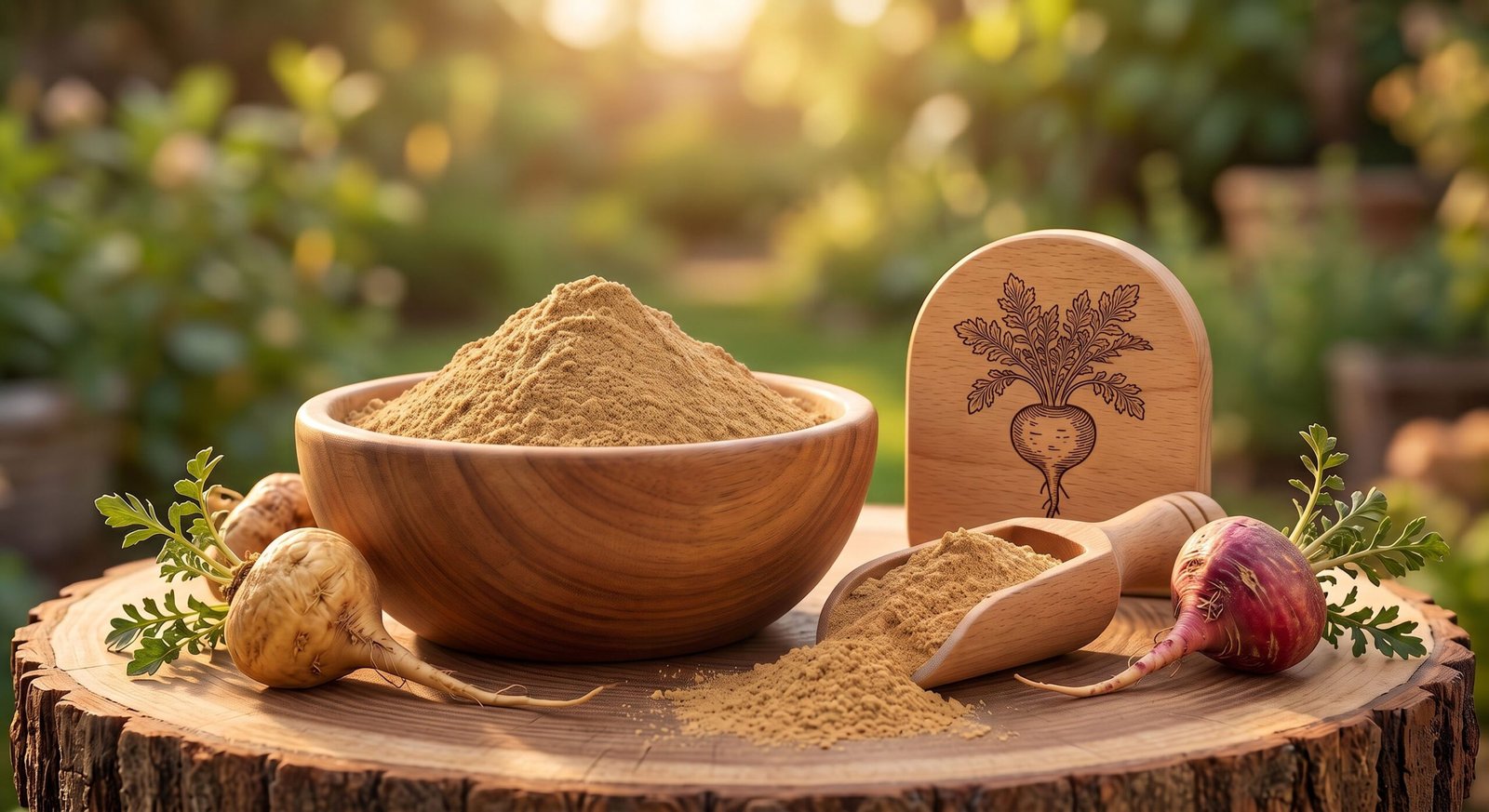
Maca root extract powder is prepared from the dried hypocotyl of Lepidium meyenii, a cruciferous plant cultivated on the high plateaus of the central Peruvian Andes. The root has been eaten as a food crop in the region for centuries and has more recently become one of the more heavily analysed botanicals in the nutraceutical supply chain. Sterols are among the lipid-soluble constituents used as a label specification for concentrated maca extracts, alongside macamides and glucosinolates.
This article covers four things:
- What maca root extract is and how it is produced
- How maca has been traditionally used in the Andes
- What modern analytical and clinical research has examined
- Why a marker specification such as 15% sterols is used at all
🌿 Explore Herbal Extract Powders
This article is educational in nature and is not intended to diagnose, treat, cure or prevent any disease.
What Is Maca Root Extract?
Maca root extract is produced by drying the harvested hypocotyl, milling it, and then extracting the milled root with water, alcohol, or a hydro-alcoholic solvent system. The resulting liquid is concentrated and spray-dried into a free-flowing powder. Depending on the solvent system used, different constituent groups are carried through into the finished powder.
Compounds reported in maca root and its extracts include:
- Macamides and macaenes — benzylamide and polyunsaturated fatty acid derivatives largely unique to the species
- Glucosinolates — principally glucotropaeolin, characteristic of the Brassicaceae family
- Sterols — including β-sitosterol, campesterol, stigmasterol and ergosterol
- Alkaloids — including the macaridine and lepidiline groups
- Carbohydrates, protein and fibre — the bulk of the dried root by weight
The colour of the source root (yellow, red or black) varies by cultivar and is associated with differences in constituent profile, which is why credible suppliers state the root colour or blend on the specification sheet.
Traditional Use of Maca
Maca has been cultivated in the Junín and Pasco regions of Peru at altitudes above 4,000 metres, where few other food crops grow reliably. It is one of the few domesticated plants adapted to that environment.
Traditional preparation and use in the Andes has centred on:
- Boiling or roasting the fresh root as a staple food
- Sun-drying the harvested root for long-term storage, then rehydrating it
- Preparing mazamorra, a thick porridge made from dried maca flour
- Fermenting the dried root into chicha de maca, a traditional beverage
- Feeding the root to livestock at high altitude
Sun-drying is worth noting because it is not merely a storage step. In traditional practice the root is dried before it is consumed, and the composition of dried maca differs from that of the fresh root — a distinction that later analytical work has had to account for when comparing samples.
What Modern Research Has Studied
Maca has been studied primarily along three lines: characterising what is in the root, developing methods to measure it reliably, and testing extracts in animal and human trials. The summaries below describe what each body of work examined, not what any product does.
Constituent Identification
Muhammad, Zhao, Dunbar and Khan (2002), publishing in Phytochemistry, isolated and characterised constituents from maca root, including macamides and a set of sterols — β-sitosterol, campesterol, ergosterol and brassicasterol among them. This work is one of the reference points for treating sterols as an identifiable maca constituent class rather than a generic plant marker.
Wang and Zhu (2019), in a review in Food Chemistry, consolidated the chemical composition literature across cultivars and processing methods. The review documents how constituent levels shift with root colour, growing altitude and drying method, and notes that much of the published human research has used small sample sizes and short durations.
Analytical & Standardization Methods
A substantial methods literature has developed around measuring maca reliably. HPLC-UV remains the dominant technique for macamide and glucosinolate quantitation, with UHPLC-MS approaches used for broader profiling of multiple compound classes in a single run. A 2026 analytical review in Foods summarises the current state of these methods and the marker compounds proposed for pharmacopoeial monographs — principally the macamides N-benzylhexadecanamide and N-benzyl-(9Z,12Z)-octadecadienamide, and the glucosinolate glucotropaeolin.
The same review notes that sterols occur in the raw hypocotyl at low levels — reported in the range of 0.01–0.1 mg/g — which is the reason sterol figures on an extract label refer to a concentrated lipid-soluble fraction, and why the analytical method behind any stated percentage matters more than the percentage on its own.
Extract Testing in Animals and Humans
Zhao and colleagues (2012), in the Journal of Functional Foods, tested a standardized lipid-soluble maca extract in a rat swimming endurance model — an example of research conducted specifically on a defined extract fraction rather than on whole root powder.
On the human side, a 2022 systematic review in Journal of Ethnopharmacology Reports examined trials of maca across several endpoints and reported the same limitation the composition literature does: heterogeneous preparations, small cohorts, and inconsistent characterisation of the material tested. Where trials did not state the extract specification, their results cannot be mapped onto any particular commercial product.
This is the practical takeaway from the research as a whole. Studies are conducted on defined, laboratory-characterised material under controlled conditions. They are not evaluations of retail supplements, and results do not transfer between preparations that differ in cultivar, solvent system or marker content.

Maca Root Extract & Sterol Standardization (15%)
A standardized extract is one manufactured to hit a stated minimum level of a defined marker compound or compound class, verified by a specified analytical method on each batch. For maca root extract powder, 15% total sterols is one such specification.
What the figure does and does not tell you:
- It is a specification, not a composition claim. It describes the concentrated extract fraction, not the dried root
- It is method-dependent. Total sterols by gravimetric or colorimetric assay and individual sterols by GC-MS are not interchangeable numbers
- It enables batch-to-batch consistency. Each lot is measured against the same target rather than varying with harvest
- It supports reproducible formulation. A formulator can calculate inclusion rates from a known marker level
- It is verifiable. The figure should appear on a batch Certificate of Analysis naming the test method used
Always read the specification alongside the method. A percentage stated without an accompanying method and CoA is not a meaningful number.
Maca Root Extract Powder 15% Sterols
Maca Root Extract Capsules 15% Sterols
Why Standardization Matters
The difference between raw maca powder and a standardized extract is knowability, not superiority. Raw powder is the milled root, and its constituent levels vary with cultivar, altitude, harvest year and drying method. A standardized extract is manufactured to a target and tested against it.
- Consistency — every lot is held to the same measured marker level
- Traceability — a stated method and CoA make the claim auditable
- Formulation reliability — inclusion rates can be calculated rather than estimated
Important Reminder
Published research on maca has been conducted on characterised material under controlled laboratory or clinical conditions. Those studies are not evaluations of retail supplements, and their findings should not be read as applying to any specific commercial product.
Final Thoughts
Maca root is a well-documented Andean food crop with an unusually large analytical literature behind it. Sterols sit alongside macamides and glucosinolates as constituent classes used to specify concentrated extracts. A marker percentage such as 15% sterols is useful to the extent that the method behind it is stated and the batch documentation supports it — which is the standard any standardized extract, from any botanical, should be held to.
Compliance Disclaimer
This article is provided for educational and informational purposes only. It does not constitute medical advice and should not be used to diagnose, treat, cure or prevent any disease. Statements regarding herbal extracts have not been evaluated by any regulatory authority. Consult a qualified healthcare professional before beginning any supplement.
References
- Muhammad I, Zhao J, Dunbar DC, Khan IA. Constituents of Lepidium meyenii ‘maca’. Phytochemistry. 2002;59(1):105–110.
- Wang S, Zhu F. Chemical composition and health effects of maca (Lepidium meyenii). Food Chemistry. 2019;288:422–443.
- Maca (Lepidium meyenii) as a Functional Food and Dietary Supplement: A Review on Analytical Studies. Foods. 2026;15(2):306.
- Zhao J, et al. Supplementation of standardized lipid-soluble extract from maca (Lepidium meyenii) increases swimming endurance capacity in rats. Journal of Functional Foods. 2012.
- A systematic review of the versatile effects of the Peruvian maca root (Lepidium meyenii) on sexual dysfunction, menopausal symptoms and related conditions. 2022.